Colocation

What Is a Data Center And What Are Its Types?

Submitted by HostingUltraso.com on

What Is a Data Center?

A data center is a space to accommodate machinery, especially computer equipment and storage devices It also accommodates dedicated servers for your business. These centers are essential for various organizations. They are small businesses, large corporations, and cloud service providers. The data centers are classified as Tier 1, Tier 2, Tier 3, and Tier 4. Tier 1 data center is the simplest form and Tier 4 is the most updated.

What Is the History of a Data Center?

The first data centers were seen in the early 1940s when the centers were used as huge computer rooms. The building costs of a data center are high and so is its maintenance. The use of data centers sky-rocketed during the dot-com bubble between 1997-2000. To enhance performance and energy efficiency, modernization of the data center is important. Also, with the rise of the internet, many companies began operating data centers. The increased demand for online services led to the necessity of data storage. After 2000, some companies introduced cloud computing. They allow businesses to rent storage space instead of maintaining their physical servers. It enabled the creation of virtual data servers. This reduced reliance on maintaining physical hardware.

The security of the data centers is of utmost importance. Physical access is only permitted if you have the correct Email ID and password. Fencing and mantraps are some of the primary security measures taken. Other than that, you can expect continuous video surveillance, CCTV monitoring, and an active alarm system. After 2010, there is an increase in hyper-scale data centers. They handle huge quantities of data and resources for global clients. Also, many business owners begin to prioritize their company's data security. So, the use of dedicated servers begin to rise in the data center for data privacy.

What Are the Different Tiers of Data Centers?

The following tiers of data centers are essential for housing your North American dedicated servers:

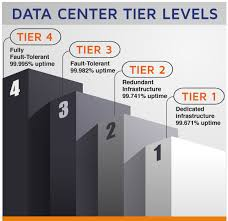
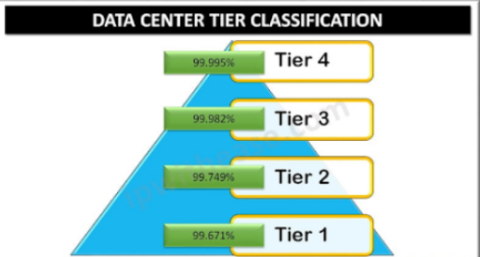
  • Tier 1: A tier 1 data center provides basic infrastructure for supporting an IT system. It has 99.671% Uptime and has 1729 minutes of downtime per annum. It is suitable for small businesses with low IT needs.
  • Tier 2: You will get redundant infrastructure, uptime of 99.741%, and 1361 minutes (22.68 hours) of downtime.
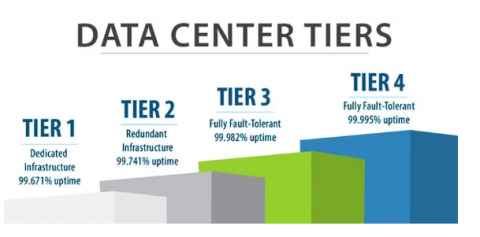
Comparison of data center tiers for dedicated server uptime and reliability

  • Tier 3: All the facilities from Tier 1 and Tier 2 are available in Tier 3. It has dual power and data center cooling distribution paths. It has redundant systems that allow any component maintenance without affecting operations. Additionally, there are more data paths and backup equipment which will reduce the downtime significantly. 99.982% is the minimum uptime you will get with a Tier 3 data center. The downtime is only 95 minutes per year. This is significantly less than the 1361 minutes per annum in Tier 2.
  • Tier 4: This is the highest level of the data center. This type of data center has fault-tolerance capabilities with 99.995% uptime and a maximum of 26 minutes of downtime per annum.

All the small-scaled business clients go for Tier 1 data centers. These are way less expensive than Tier 2, Tier 3, and Tier 4 data centers. That makes sense for the server providers who have small-scale businesses as their clients. Such clients will look for cheaper servers to host their websites online. This can be a cost-effective solution for small businesses. The Tier 1 data centers are mainly used for colocation.

The data centers bring with them a dynamic infrastructure. They help secure and automatic workload movements across a data center. There are certain side benefits associated with data center infrastructure. It also enables cloud and grid computing.

What Are the Characteristics of a Tier 1 Data Center?

The most basic form of a data center is the Tier 1 form. You can classify it as the basic-intermediate level of a data center. To be called a Tier 1 data center, the center has to adhere to the following:

  • Single Points of Failure: Tier 1 servers are prone to single failure points. So, it is important to maintain each component. This includes its power, cooling and network.
  • 99.671% Uptime Per Year: You can expect a minimum of 99.671% uptime per annum. This helps in maintaining dedicated server stability of small and medium businesses. So, your company carries out daily functions without any online disruption.
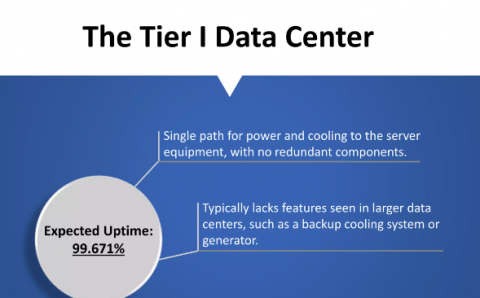
Tier I data center basic infrastructure for North America dedicated server

  • Zero redundancy: The tier 1 data centers dont have any kind of redundancies on any part of the system operations.
  • Single Power And Cooling Distribution Path: There is only one cooling and power distribution path. So, the failure of power or cooling systems leads to data center downtime. Also, there are uninterruptible power supply systems to protect against power losses.
  • Low Cost: They are less expensive to build and require low maintenance. They are suitable for smaller businesses that have low budgets.
  • Basic Security Measures: They have basic security measures including physical security. These include system locks and surveillance measures.

What Are the Characteristics of a Tier 2 Data Center?

Some features of Tier 2 Data Centers are

  • Reductant Capacity Components: Tier 2 data centers have redundancy for various critical systems. These include power and cooling and are configured as N + 1. N is the capacity required to support a data center operations. + 1 is referred to as an additional backup component.
  • Improved Uptime: These data centers provide an expected uptime of 99.741%. Your Asian dedicated server's higher uptime builds customer trust.
  • Single Power And Cooling Path: They depend on a single distribution path for cooling and power. Although some components have backups, a fault in the key distribution path causes downtime.
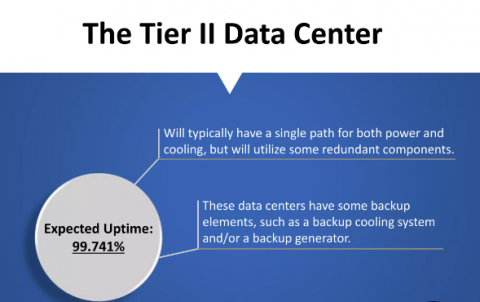
Tier II data center with redundancy support for Asia dedicated server hosting

  • Protection from Failures: They provide greater protection than Tier 1 against hardware faults and power cuts. Data center servers can handle critical failures from previous-tier servers.
  • Moderate Cost: They are cost-effective for small and medium-scale businesses. These data centers provide full redundancy and fault tolerance.
  • Security: They have stronger security measures than Tier 1 servers. Your company data will be safe in the Tier 2 data center.
  • Use Case: It benefits small businesses that can tolerate some downtime. However, they need better protection against systematic failures.

What Are the Characteristics of a Tier 3 Data Center?

Some features of a Tier 3 Data Center are:

  • Maintainable: These data centers are designed to allow maintenance of any component. This is done without disrupting a system operation.
  • Redundant Cooling Paths And Power: This data center has a minimum of two cooling center paths. One path is active at any time. Another path serves as a backup if the primary path fails.
  • Higher Availability And Uptime: These data centers have an expected uptime of 99.982%. This higher uptime ensures crucial operations with low disruptions.
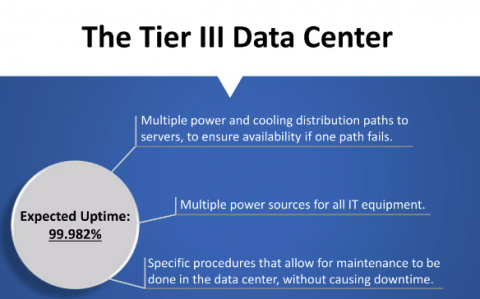
Tier III data center ensuring fault tolerance for Europe dedicated server hosting

  • Fault Tolerance: This data center design ensures planned maintenance and upgradation without impacting an operation facility.
  • Backup Power Systems: They have backup generators that provide machinal power during power outages.
  • Improved Security: They have advanced security measures. This includes biometric access and surveillance. It prevents unauthorized access to your company system. As a result, it maintains Europe dedicated server security.

What Are the Characteristics of a Tier 4 Data Center?

Some features of Tier 4 data centers are:

  • Total Fault Tolerant: They are fully fault tolerant. This means they can continue to operate even if critical infrastructure fails. They have a backup for cooling, power or network systems.
  • Multiple Cooling Paths: A Tier 4 data center has both cooling distribution paths and dual powers. Both paths can handle the data center entire load. Also, if one path fluctuates, another path gets activated.
  • Highest Uptime: It offers an expected uptime of 99.995%. It has the highest upkeep levels across all data centers. This helps your Oceania dedicated server's stability and smooth execution of workplace tasks.
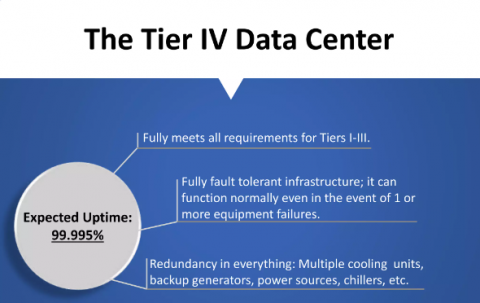
Tier IV data center with 99.995% uptime for dedicated server hosting

  • Concurrent Maintainability: You can perform system maintenance without any downtime. If there is a failure in one system, another system starts automatically.
  • Advanced Cooling Systems: It has advanced cooling systems. This ensures that the equipment remains within a safe temperature and humidity range.
  • No Single Failure Points: Every crucial component has an independent backup. This applies to cooling, networking and power.
  • High Cost And Complex: They are very expensive to build due to advanced equipment requirements. Also, continuous maintenance costs need high capital. Also, its complex infrastructure requires highly skilled personnel for maintenance.

Summary

The definition of a data center and its various types are written here. First, there is an explanation of the history of data centers. The usage of data centers increased during the 90s. The reason is that companies prioritize a safe storage space for business data. Also, there was an introduction of cloud computing services. This enabled businesses to rent storage spaces from a cloud service provider. After that, the various types of data servers are written in brief. Tier 1 data center is suitable for small and medium-sized businesses. Tier 2 data center has better facilities than Tier 1 servers. They have stronger power fault tolerance capabilities than the previous tier. Apart from this, Tier 3 data center has higher uptime and backup systems. This is suitable for large companies that need to preserve huge information. At last, the Tier 4 data center was explained. It has the highest uptime, advanced cooling systems and is fully fault tolerant. This server is suitable for conducting international business. Installation of an Africa-dedicated server or other location in your data center is essential. It keeps your business data secured from hackers.

CTA

Get the best-dedicated servers for your business from our Tier IV data centers.

Closing Thoughts

A data center is becoming an important part of today businesses. They are built to protect systems from data thefts. You can set passwords, biometric security or cameras to protect your critical information. There are four tiers of data centers. You can choose your preferred center as per your business needs. Also, install a dedicated server in your data center for data privacy.
Tier 2 Data Center: All Things Need To Know

Submitted by HostingUltraso.com on

What Is a Data Center?
A data center is a physical room and facility that houses IT infrastructure for building, running and delivering your business applications and services. It also stores and manages your business data associated with your applications and services. This is a centralized location where your company IT infrastructure is managed by a dedicated server provider.

Data center tier classification with uptime levels for Denver dedicated server hosting

What Are the Key Functions of a Data Center?
The key functions of a data center are:
Data Storage
A data center assists in storing a large quantity of business data, including databases, backup, files and other media related to your business. It also uses various storage systems like Storage Area Network, Cloud Storage and Network Attached Storage.

Network Connectivity
A data center helps in connecting the external users and internal systems to various resources using high-speed internet. It also has firewalls, switches, routers and load balancers for ensuring your smooth business data flow and maintaining security.

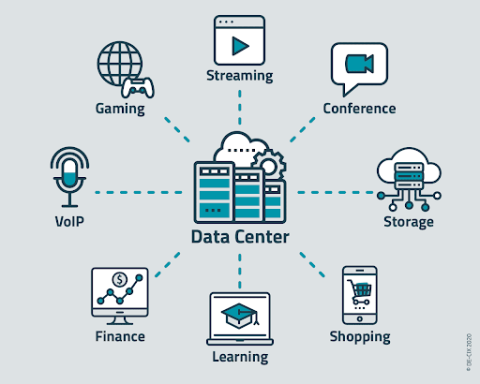
Data center functions supporting gaming storage and dedicated server workloads

Data Processing
A data center also assists in handling complicated calculations and ensures smooth data transactions using real-time analytics. This helps in running your business applications smoothly and provides services to your customers faster.

Backup and Disaster Recovery
It also provides backup solutions to protect your data loss. This ensures faster recovery of your system from cyber attacks, power failures and natural disasters.

Security Management
A data center has a firewall that protects your dedicated server from cyber breaches. As a result, your organizational data remains protected. The encryption option enables you to edit your user ID and password whenever required to prevent unauthorized access. It also follows various compliance standards.

Cooling and Environment Control
A data center maintains an optimal temperature to protect your dedicated server hardware. This applies to any location dedicated server, including Denver dedicated server. It also uses modern HVAC systems to prevent overheating of your server physical hardware to avoid system damage.

Monitoring
A data center examines your system performance, helps your dedicated server maintain 99.99% uptime and handles your website data traffic. It has dashboards to provide real-time alerts in case of server maintenance.

What Are the Four Tiers of a Data Center?
First, Tier 1 data center: Tier 1 data centers are helpful for start-ups and small businesses with limited budgets. They are cost-effective, simple to set up and easy to manage.
Next, Tier 2 data center: This type of data center offers increased reliability and 99.741% uptime for running a business operations. It is suitable for small and medium-scale business data protection.

Data center tier levels showing uptime standards for North America dedicated server hosting

Then, Tier 3 data center: This data center supports your most critical data operations. They provide higher uptime and improved fault tolerance. This data center is suitable for running high-traffic websites like e-commerce and streaming services.
At last, Tier 4 data center: A Tier 4 data center has a maximum uptime of 99.995% and strong fault-tolerant capabilities. They comply with strict regulatory requirements for maintaining critical applications. It is beneficial for large institutions like financial institutions, telecom and energy companies.

What Are the Benefits of a Tier 2 Data Center?
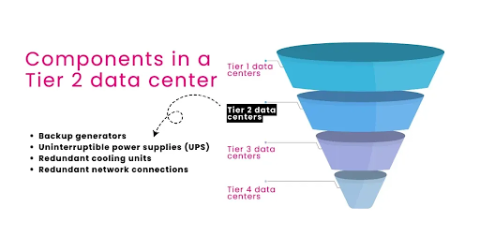
First, Improved Reliability over Tier 1: It has redundant capability components that reduce downtime compared to Tier 1 data centers. For example, UPS systems and additional cooling units.
Next, It is a Cost-effective Solution. It is more affordable than Tier 3 and Tier 4 data centers, thus making it ideal for small and medium-sized businesses.
Also, It Has Redundant Power and Cooling Systems: It reduces downtime risks caused by single points of failure. It ensures partial redundancy in power due to its cooling infrastructure.

Tier II data center components supporting dedicated server reliability

Also, It Has Enhanced Security over the Tier 1 Data Center: A Tier 2 data center offers better security measures than a Tier 1 facility. This includes CCTV surveillance, controlled access and fire suppression systems. The feature is available for a New Jersey dedicated server or any business location's dedicated server.
Apart from This, it Provides Scalability for Growing Businesses: It provides flexibility to growing businesses in adjusting their online workload without disrupting their business operations.
At last, it has good disaster recovery options: It provides basic data protection against unexpected power failures for small and medium businesses.

Hence, it can be concluded that a Tier 2 data center is a practical choice for businesses that balance both cost and reliability. If you are a small company planning to grow your business, a Tier 2 data center is best for you.

So, that it from me. Hope this has been useful for you in understanding the benefits of a Tier 2 data center for your business.

Final Remarks

A Tier 2 Data Center is beneficial for dedicated server maintenance of small and medium-sized companies.

This provides higher uptime for your company dedicated servers compared to Tier 1 data centers.

It gives enhanced security measures to the dedicated servers, including CCTV camera surveillance, authorized system access.
You can service individual components of your dedicated server without any downtime, thus ensuring continuity of business operations.

A Tier 2 data center has backup systems that assist in recovering your data without requiring constant access.

It can be concluded that a Tier 2 data center provides a balance between cost and performance. This is the best choice for businesses that require the best reliability within an optimal budget. Email us at sales@hostingultraso.com to obtain your preferred dedicated server from our Tier II data centers.

Why your company needs a Data Center?

Submitted by HostingUltraso.com on

What Is a Data Center?
A data center is a specialized facility that is used for housing computing equipment, including dedicated servers, network infrastructure and storage systems. This is for processing the daily business data. This is a centralized physical location where companies store their business information. They are privately owned and located on a tightly secured on-field premises. A Washington dedicated server or any dedicated server is housed in a data centre, as it provides the resources and infrastructure for managing it. It also provides the physical space, power and network connectivity that a dedicated server requires. Whereas a business owner uses the server resources for their particular business needs. There are four tiers of data centers, namely tier I data center, tier II data center, tier III data center and tier IV data center.

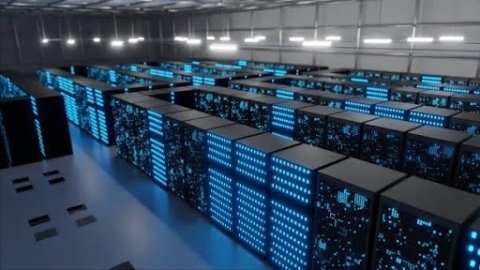
High-performance data center infrastructure supporting dedicated server hosting

Why Is It Important for Your Business?
These are the reasons why a data centre is important for your business:
Centralized Data Management: The datacenter is an amazing feature that can hugely facilitate your business. It is a network of computers and databases that will help you to organize, control, manage, store and process your bulk data that is essential for your routine activities or operations. This is relevant for businesses using a Morocco dedicated server or any location dedicated server.
High Performance: For business continuity, different IT operations are very important and therefore having a data center for your business becomes important as well. The reason is that it can give you backup components and infrastructure for supplying power to an Albania dedicated server or any dedicated server. This includes battery banks, generators, data communication connections, environmental control(computer room air conditioners, heating, ventilation, and exhaust system), etc.
24 X 7 Support: It helps you by providing service 24x7x365. It not about good space management, but modern data centers are coming with reliable power and network management facilities. So, as a business person, you should opt to have it. It is doing sophisticated work as an extension of your IT team, or in case you dont have an IT team, you can have the facilities of the data center for your business as an efficient IT team.
Assist in Running Crucial Operations: Some crucial IT operations, like running e-mail, instant messaging service, providing cloud storage facilities, enabling e-commerce transactions, etc., are facilitated by the data centers.

Disaster recovery solution to protect data on a Rome dedicated server
Scalability: A data center offers businesses the flexibility to upgrade their IT infrastructure depending on their business need. This includes your dedicated server storage infrastructure for any location, such as a Rome dedicated server. You can adjust your server capacity in case of a sudden higher business demand online, without facing any network disruptions or financial losses.

Security: It has strict physical security measures such as access control, CCTV surveillance and security personnel. This protects your dedicated server and business data from unauthorized access. A data centre also has strong security protocols, including firewalls, encryption facilities and intrusion detection systems. This is for protecting sensitive information from cyber threats.

Redundancy and Disaster Recovery: It has disaster recovery capabilities that assist companies that are widely dependent on heavy data. The presence of redundant and multiple systems ensures that data is always available, even in network connectivity issues during a natural disaster. A data centre data backup features ensure your business data recovery during a cyber attack.

Cost-effective: With the help of a third-party data center provider, you only need to pay for the dedicated server services that you use for your business. The data center upgradation and maintenance cost is borne by the third party data center provider. This helps in controlling your organizational budget.

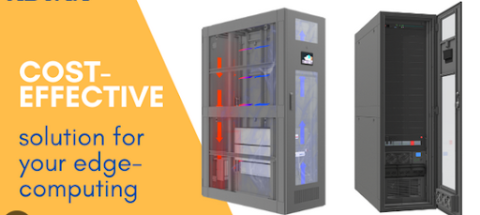
Cost-effective Washington dedicated server solution for edge computing workloads

Compliance: Data centers follow a wide range of data center compliance standards, like ISO 27001, PCI DSS and HIPAA. It shows the commitment to strong data security practices. This instills confidence among business owners in trusting the data centers for protecting their critical information.

Summary
In this video, there has been an analysis of the importance of a data center for the maintenance of your company dedicated server is presented. At first, the definition of a data center is written. It is a centralized location where a company saves all the critical information of its business. This provides the infrastructure to manage your dedicated server, whether a Massachusetts dedicated server or any location dedicated server. Then, the importance of a data center for your business is analyzed. It is seen that the centralized feature of a data center assists in keeping your business data organized necessary for your routine activities. You get round-the-clock technical support from the data center IT team in case there is a power or network management issue in your dedicated server. Further, a data center helps in running the crucial operations of your business, including instant messaging and e-commerce messaging with your customers.
Apart from these, a data center provides the scalability to adjust the IT infrastructure of your dedicated server, aligning with your organizational needs. Also, the stringent security features assist in securing your dedicated server from unauthorized access. The backup features prevent data loss in case of a cyber attack. At last, it is a cost-effective option for your business, as you need to pay only the service charge of your dedicated server and not the maintenance charge. It would be borne by the third-party data center provider.

CTA
If you want a dedicated server that is supported by a Tier IV Standard data center, email us at sales@hostingultraso.com. Our dedicated servers support businesses in 119 cities worldwide.

No COVID-19 Worries: Hosting Ultraso Committed to Delivering Endless Servicing

Submitted by HostingUltraso.com on

As everybody knows Covid-19 has hit hard the business and the global economy and in such a pressure situation, Our assurance is still there to our clients that œ Do not bother as Hosting Ultraso is your genuine web host for your site. Your business and website both are in the safe hands with a premium service experience that never ends.

Our delivery is for a fast, robust, powerful, and continual dedicated hosting supply and we are devoted to the service we offer you like our Dedicated Servers.

We Deliver You a Full Planned REMOTE Servicing

The remote operations have become so much demanding with an increased spread of COVID-19 and with this increasing spread, you might be worried about the successful accomplishment of remote operations for your business.

Well, just do not be tensed high as we have a fully planned remote program for you functioning 24/7/365 with full safety and reliability. We are operating globally and there are our data centers located in more than 119 countries working tirelessly, providing the proper server uptime so that you get the lowest latency rate.

We have advanced remote monitoring technology and updated hardware and software setup with full proof protection to the setups.

In any uncertainty which may occur in such a situation, with our professional experience and knowledge we can deal with those efficiently to make the remote operation uninterrupted anywhere in the world and you will never get any delay.

Hosting Ultraso: Ready to Serve All Time

We have a professional and expert team that will be there 24 hours a day to meet all your business needs and specifications and in any case, if you need any help, we will be right there to help.

We have been continuing the service that never stops since we did start and our guarantee is to our clients that they will never face any problem with our hosting service as we deliver the best.

Be it a business payment transaction, dynamic E-commerce application, or gaming sites, we will supply nonstop service.

In the end, we only wish for the safety of yours. With sound health and mind, you do work in a progressive way and we are the back support. We want to thank our clients for their continued support and faith in our service.

We look forward to a stronger connection with you. Few times we regret in cases that there may be few delays as we have third party connections and also that in such an atmosphere different government rules and policies have been put globally.

Hosting Ultraso is not stopping and will not let you stop.

The Potential & Optimistic Impact Of COVID-19 On The Technology World

Submitted by HostingUltraso.com on

There is a severe effect of Covid-19 on the world revolving around us and so does on the global business platform. There is a compelling impact on technology too.

At every sphere of the modern business process and marketing process, technology has its immense role to play. Starting from the manufacturing of products to successful end to end delivery, then marketing setup, in each step you get the technology running behind the whole system.

Be it a core technical business or a general business making progress with dependency on technology, now have stepped towards to deploy the business activities needed to be done remotely. The work from home culture is the scenario right now and we have been moving ahead with one and only technological dependencies. The situation has made the business world do its business from home increasing the prospective of technology services. This approach is opening a new path and a strong challenge at the same time for IT industries.

What are the omnipotent possibilities of technology?

The situation is such now, that we are in the reach of the world via technology and here the technical business has got the exposure. Other businesses want to make themselves stronger and create a solid base for setting an attitude of œno lockdown effect on their businesses. Hence, there is a need for some powerful technical assistance and solutions that opening the challenging but prosperous horizon for the technical world. Well, there is a challenge for the data centers too to mobilize and optimize the carbon emission reduction.

Massive Demand Of Software and Hardware Tools

As mentioned, the ever-growing demand for the technical services and tools to make the remote operation successful is now visible in every part of the world. Companies that build and design technical equipment and tools, applications have already started facing huge customer demand.

Hardware manufacturing companies have a high load on their shoulder to ensure the large supply of hardware devices like mobile, laptop, rooter, and so on.

There is a higher demand for Security Software to carry forward the smooth and uninterrupted running of remote work. Small to Large Organisations and companies have participated in the digital race and therefore need the best technological solutions for leading the race and give an impactful competition to the opponents. The employees are working from home and the priority is to set a compact and well-secured set up for the employees to deliver better business service.

This has in chain making the IT industries to work more on server-based tools, log handling system, and VPN servicing. The tech companies, enterprises, organizations have also got involved in the business race.

IT Operational Services

There is the increment of Server infrastructure servicing and in such a case people keeping their faith on the Dedicated Hosting service to get the optimum load balance from the data center, lowest latency rate, fast rendering of websites and robust hardware setup with effective security applications software to make the business site perform with enhanced flexibility and scalability. So, the client gets a quality experience.

The demand for telecommunication has visible as most of the companies let their employees to the ultimate work from home concept and need excessive teleconferencing and video conferencing as well. Schools are shifting for online courses and classes and several institutions arranging the online tutorial.

There are some other scenarios as well, as a large number of business organizations have no such tech-savvy setup and management and hence relying on the IT companies. IT departments working hard to meet up the business specifications and provide better setup and management tools and applications to maintain the business flow with more ease and fluidity.

Network speed is also importantly escalated and the requirement for 5G net speed for network communications has become the future plan for companies providing high-speed internet.

Network Equipements

The maximum use of teleconferencing has raised the need for telecommunicating software. Fast data access and automated updation making a sought for having a 5G speed network to meet up the challenge of fastening the business activities.

Key Question: How do we promote technology to future working?

The situation itself has curved the path to unfolding possibilities of future technology as we already have got a glimpse that how deeply the world depends on the technology.

As we can see today from every aspect of lifestyle, people want everything as fast as possible. The easy and fast solution. Tech companies have to make things even faster way than what it is today. The network speed, bandwidth capacity everything will be mattering as the world will want to get fast access to data, automatic updation, and smooth communication.

The telecommunicating software with more enhanced security software will be in incremental demand. Businesses will require more proactive technology service to make progress and server hosting infrastructure will be largely promoted with next step thinking.

AI, IoT(Internat Of Things), Data Science, these core technical fields will be more demanding for the next level of innovative exploitation in the technology world to make things super smart, super fast.

Handy digitized tools and applications are going to be the future tools to do any kind of business that can easily give the desired solution and suitable result. Real-time monitoring, remote servicing with proper log management, and security management will be more appealing.

Technology will be in the next level of evolution.